Korea Search Field Report · Sep 2026
The Day Naver Deleted “Popular Posts”
Naver handles the overwhelming majority of local-intent search in South Korea, and for years its mobile results ranked blog and cafe content inside a labeled block called Popular Posts. On September 3, 2026, that block vanished for restaurant-discovery keywords. Our proprietary AI rank-tracking system, which collects client visibility daily, caught the change within hours. This is a first-party account, written by the team that measured it.
In one paragraph: nothing was deleted and no site was penalized. Naver dismantled the labeled ranking block and scattered the same posts into unlabeled cards across the first screen, starting with region-plus-restaurant discovery keywords. Partial restoration began the next day for some users, a staged-rollout pattern Naver has shown before. Businesses that keep daily visibility records rode through it; those relying on single snapshots were flying blind.
Same store, same keywords, 21 hours apart
At 3:05 PM on September 2, our system logged 19 first-screen rankings for one Busan restaurant client across its tracked keywords, several in first and second position. At 12:51 PM the next day, the identical automated collection returned zero matches on all 42 keywords. The posts were untouched. What disappeared was the container that gave them countable positions.
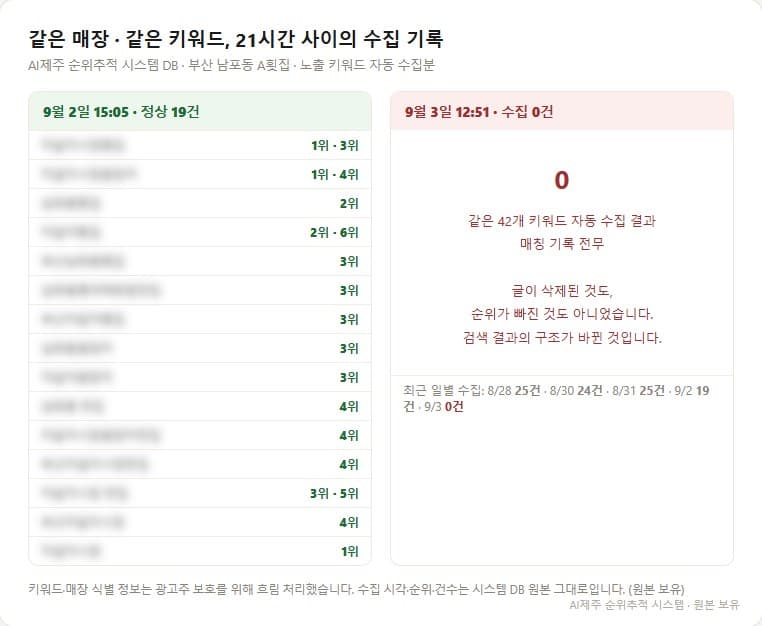
A simultaneous crash across 42 unrelated keywords cannot be explained by content problems. When we pulled the raw search pages, the answer was structural: the string “Popular Posts” had zero occurrences in documents where it had appeared dozens of times a day earlier.
What the new layout looks like
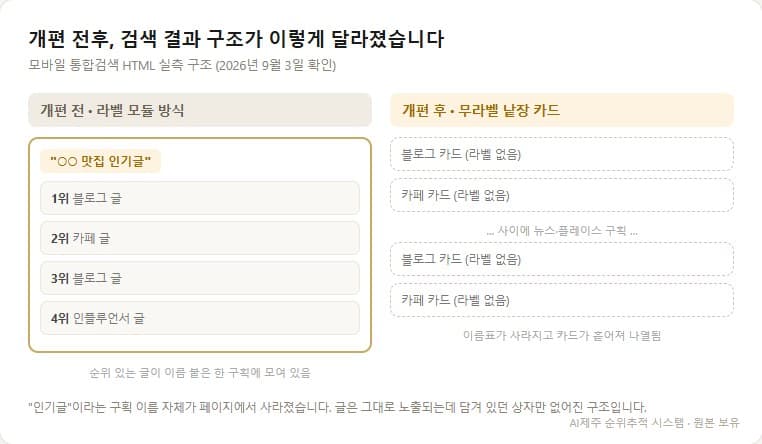
The old layout grouped ranked posts inside one labeled box. The new one renders each post as a standalone card, unlabeled, interleaved with news and map modules. Positions still exist in the sense that cards have an order, but the visual frame that made rankings legible to shop owners is gone. Counting them now requires filtering duplicated card markup, which our parser had to relearn the same afternoon.
Not all keywords were hit
Same-day sampling across keyword types showed a clean pattern. Product keywords such as appliance names kept the block in 4 of 4 checks. Single-dish keywords were mixed at 2 of 4. Region-plus-restaurant discovery keywords lost it in 4 of 4. The overhaul targeted local discovery first, which is exactly the territory where Korean restaurant marketing lives, and why the shock concentrated there.
Detected, diagnosed, and re-tracked within a day
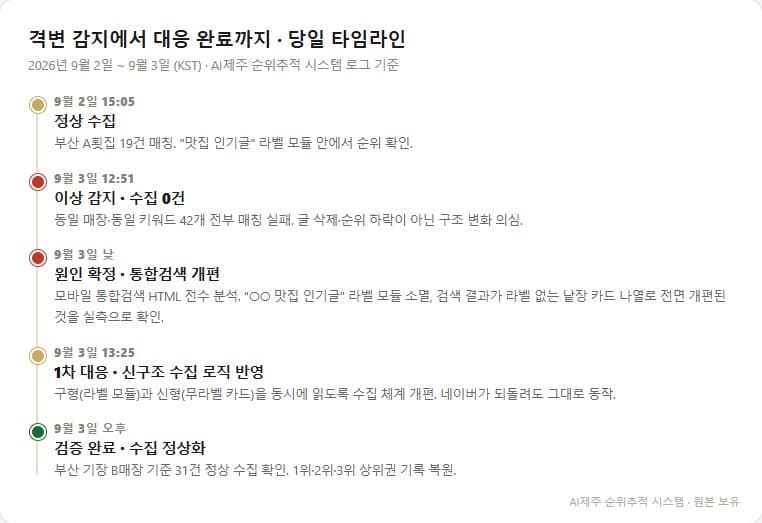
Because collection runs daily, the zero reading itself was the alarm. Root-cause analysis of the raw pages confirmed the structural change by early afternoon, our parser was rebuilt to read both the old and new layouts, and by evening a different client's collection returned 31 healthy rankings under the new structure. Whichever layout Naver settles on, the records continue without a gap.
From the following day, some users began seeing the Popular Posts block again while our channels still received the new layout on many keywords: a mixed state consistent with a staged rollout being tuned in production. Stabilization is likely; its final shape is Naver's call.
If Korean customers matter to your business
Three practical moves. First, open an incognito mobile session and search your core Korean keywords; confirm what actually shows on the first screen today. Second, record positions daily during this transition, because a single snapshot in a mixed rollout will mislead you in either direction. Third, if an agency hands you a ranking number this month, ask how it was counted; reports that cannot answer that question are measuring the old world.
We publish this because our clients’ records let us see the change the hour it landed. If you want your Korean-market visibility watched the same way, daily, by a system built for it, we are easy to reach.
Ask us about your Korean search visibility
Send your business name and target keywords. We will check the current first-screen state under the new layout and tell you what we see.